
For years, we have heard tales of the negative consequences social media has on teenagers’ mental health. The major tech conglomerates behind these networks have spent the past decade defending their platform algorithms in courtroom trials, facing landmark multi-state lawsuits and paying out multi-million dollar settlements over accusations of designing addictive features that fuel youth depression, body dysmorphia and anxiety.
This has all culminated in 2026 in a sweeping array of social media bans for young teenagers across the globe. The Australian government has been a first-mover, banning teens from accessing popular platforms such as TikTok, Instagram and X until the age of 16.
Governments across the United States and Europe rapidly followed suit. In the U.S., states passed strict age-verification mandates like California’s Protecting Our Kids from Social Media Addiction Act and Florida’s HB 3, while the U.S. Federal Courts enforced strict compliance deadlines on Meta and ByteDance. Simultaneously, European regulators leveraged the EU Digital Services Act (DSA) to enforce strict systemic age-gating across all major VLOPs (Very Large Online Platforms), forcing Meta to disable algorithmic recommendation feeds for unverified minors across the European Union.
As expected, the reactions to the bans have been mixed. While some lament what they perceive as the revocation of their freedom of expression, others (often, parents) welcome the tighter restrictions on what teens are exposed to online.
In policy halls, the victory was declared in binary terms. Advocates of the bans celebrated a victory for youth mental health, while critics warned of civil liberties erosion and digital disenfranchisement. But both sides were evaluating the policy through a narrow, immediate lens: Did the ban work? Did screen time go down? Do teens feel better? Only time will tell.
Strategic foresight, however, teaches us that human systems rarely react in simple binaries. When you restrict access to primary infrastructure used by an entire demographic for social connection, that underlying need for connection does not evaporate. Top-down bans do not erase youth culture, but instead they force it to adapt, innovate and migrate into new spaces.
To truly understand the long-term impact of these mandates, we must look beyond first-order compliance and ask a deeper, ten-year question:
By 2036, what has a decade of age-gated social media done to how teens form friendships and identities?
For brand strategists, consumer marketers and commercial leaders, this is far more than an academic exercise. The answer to this question will dictate how huge annual media budgets, product innovation and brand engagement must flow over the next decade. If teenagers are no longer accessible through centralised social feeds, how do commercial organisations maintain relevance with the consumer cohort of tomorrow?
To answer this, we cannot rely on mainstream headlines or speculative opinion. Instead, we must look at weak signals: early, localised human adaptations occurring at the fringes of technology, commerce and social life today. By tracking how young people are already navigating perimeter locks, identity gates and screen-free environments in 2026, we can map the long-term structural shifts – and brand opportunities – that will define adolescent life over the next decade.
Predicting the future is hard because it doesn’t move in a straight line. Too often, predictions lean on a single binary outcome: either the policy succeeds or it fails. Instead, we need to look at the unexpected outcomes.
By stepping back and looking at early adaptations happening around us today, two critical questions emerge that will dictate the next decade:
There are many ways to think through these two questions, from horizon scanning frameworks to data-driven methodologies. All of them will necessarily prove imperfect in one way or another. One way to map them out is using a quadrant-based approach, identifying four possible scenarios with different relationships to enforcement, as well as the analogue and digital worlds.
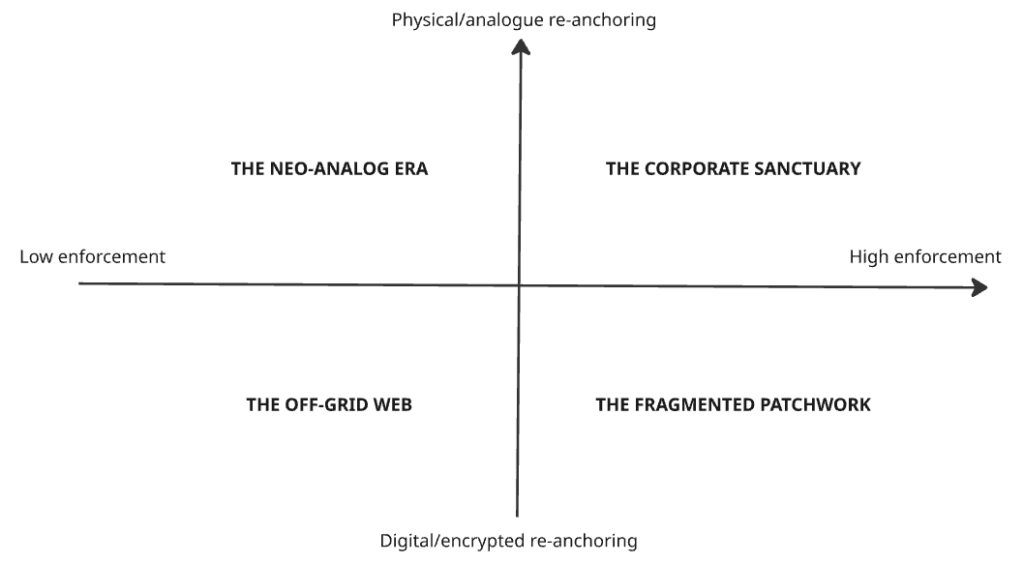
None of these quadrants represents a guaranteed prediction. Instead, they serve as a framework to stretch our assumptions. By examining how young people form friendships and identities across each of these four worlds, we can see how top-down restrictions could reshape youth culture in fundamentally different ways.

Quadrant 1: Low enforcement, physical re-anchoring
Imagine walking through a high school hallway in 2036. Leaving your phone powered off inside a physical locker is a deliberate social flex. The most popular after-school gathering spot isn’t a public server or a viral livestream, but a sunlit corner of the local public library where a dozen teenagers are clustered around a tabletop board game. In this world, government age-verification mandates technically exist, but technical enforcement remains porous and easily bypassed.
However, a sweeping cultural counter-reaction renders public social media feeds largely irrelevant to teenagers anyway as having a public online presence has lost its cultural capital. Being constantly available on a digital feed is viewed as low-status and as a sign that your attention is being harvested for ad revenue, whereas remaining intentionally unreachable signals self-discipline, autonomy and social prestige.
Because public broadcast algorithms no longer dictate youth culture, teenage friendships contract back to immediate physical geography. In the Neo-Analog Era, social circles are anchored in neighbourhood walking routes, school perimeters and non-commercial third places. Lacking social platforms to discover peers, young people rely on physical proximity, gathering in municipal youth lounges and community centers to build unmediated, low-pressure relationships.
Identity formation undergoes a similar analog shift. Self-expression moves away from algorithmic validation loops and curated profile grids toward tangible, physical artifacts. Teenagers project who they are through hand-crafted print zines and “dumb” hardware like Y2K-era flip phones and standalone digital cameras and physical media collections. These physical items carry high social value because they are permanent, un-tracked and immune to being altered or revoked by corporate platform terms of service.
This future is directly anchored in early behavioral shifts already visible today. In addition to parental restrictions, qualitative reporting on Gen Alpha by the New York Times reveals an emerging internal backlash among young people themselves, with kids expressing screen exhaustion and a desire for technology to be more intentional. Youth subcultures are intentionally seeking out friction and gravitating towards activities that require more effort.
At the same time, educators observe a growing parental pivot away from early screen exposure, while municipal governments and urban library systems are reallocating physical floor space to dedicated, non-commercial teen lounges and tabletop gaming circles.
The conditions for a Neo-Analog Era may already be forming.
Quadrant 2: High enforcement, physical re-anchoring
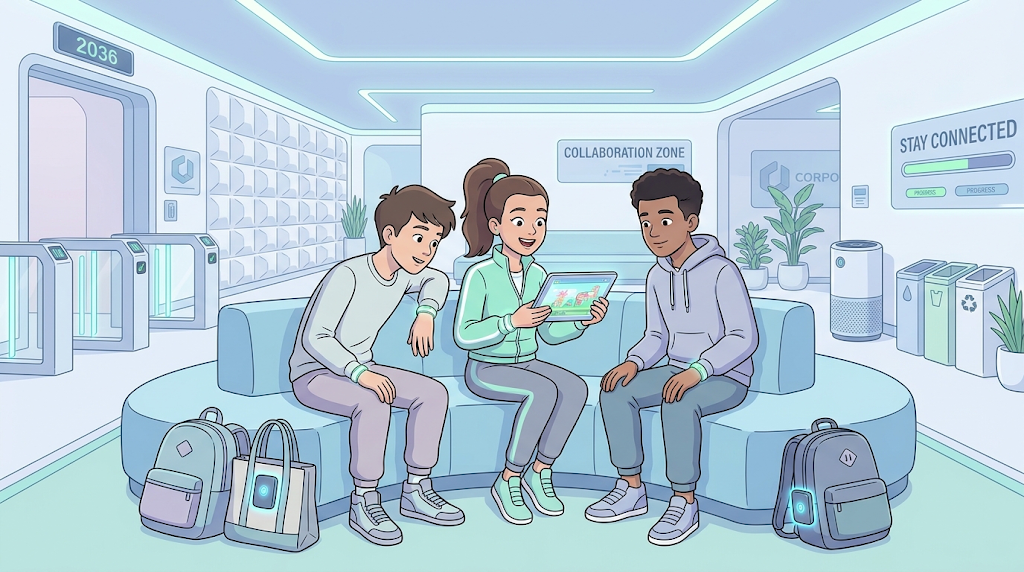
Step up to a high school perimeter gate in 2036. An automated RFID scanner reads your wristband, unlocks your phone pouch and grants entry to a corporate-sponsored youth lounge where every screen interaction is monitored and pre-moderated for emotional safety. In this world, state age-gating legislation is strictly enforced through mandatory hardware checks, biometric identity passports and strict perimeter bans. Private corporations step in to fill the massive market vacuum, constructing heavily moderated, sanitised alternative ecosystems (both online and offline) that comply with stringent state “duty of care” legislation.
Under this regime, youth socialisation is systematically funneled into vetted, corporate “walled gardens” and sponsored offline recreation hubs. Open-ended algorithmic discovery is replaced by heavily moderated micro-networks that prioritise physical and emotional safety over open exploration. Friendships form within pre-approved digital boundaries, where algorithmic recommendation feeds are disabled and social interaction is mediated by verified, age-bracketed accounts designed to shield minors from unvetted peer contact.
In the Corporate Sanctuary, identity formation becomes highly performative and pre-censored. Teenagers adapt their self-expression to operate within pre-programmed platform guardrails, where computer-vision models scan images and text for compliance before content can ever be published. Young people learn to present sanitised, idealised personas that satisfy automated moderation parameters, effectively internalising regulatory standards into their daily creative output.
This future builds directly on emerging commercial compliance infrastructure and regulatory trends visible today. Tech startups are already capturing tween and teen screen time by building COPPA-compliant, direct-message-free video applications explicitly designed to operate under legislative bans. Schools and event venues enforcing physical phone bans increasingly rely on magnetic locking pouches and single-use RFID wristbands, generating specialized physical compliance waste streams. At the same time, public policy discussions are shifting away from simple user access bans toward mandatory structural platform regulation, forcing social networks to disable recommendation algorithms for minors entirely.

Quadrant 3: Low enforcement, digital re-anchoring
Imagine a 15-year-old in 2036 adjusting their real-time camera feed filter before joining an online classroom or gaming platform. To the automated age-gating algorithms scanning the connection, the user appears as a verified 24-year-old adult living in an exempt international jurisdiction. In this world, government age-verification mandates remain active on paper, but state enforcement systems fail entirely against continuous, sophisticated technical bypasses. Minors live in an open legal gray zone, “banned” from public platforms by law, but operating en masse across the mainstream web using synthetic identities, off-grid network tools and decentralised residential proxy tunnels.
Under this regime, teenage friendships remain globally digital, but they are built on a foundation of structural evasion. Young people form connections across mainstream gaming and social platforms by sharing and trading custom bypass scripts, synthetic identity assets and residential network access. Friendships are forged through shared technical literacy and mutual subversion of state surveillance; knowing how to navigate around digital perimeters becomes a foundational bonding ritual among peers.
Identity formation is fully detached from real-world, legal identity. Because accessing digital platforms requires spoofing verification gates, teenagers develop highly sophisticated synthetic alter-egos. Young people maintain compartmentalised online identities complete with AI-generated biometric markers, secondary camera streams and falsified digital footprints. Rather than presenting an authentic or curated version of their offline self, teens learn to view digital identity as a fluid, technical construct: a mask designed to deceive platform moderation systems while protecting their real-world privacy from state surveillance.
This future is directly anchored in technical vulnerabilities and legal friction already emerging today. Basic physical workarounds have quickly evolved into advanced AI toolkits, with users leveraging deepfake facial generators and virtual camera feeds to bypass automated liveness checks. At the same time, commercial VPN usage and multi-hop residential proxy tunnels continue to undercut geographic age-gates, while civil liberties groups actively mount free-speech legal challenges against state-mandated digital identity checks.

Quadrant 3: High enforcement, digital re-anchoring
Imagine a 15-year-old coming home from school in 2036, powering up a laptop and dropping into a persistent, encrypted voice channel on a private micro-server. There are no public follower counts, no algorithmic discovery feeds and no viral broadcast mechanics. Instead, five friends sit together in low-intensity, ambient co-presence for hours: studying, listening to music, or building shared virtual worlds. In this world, state enforcement successfully blocks under-18s from public, commercial social media platforms like TikTok, Instagram and X. However, instead of returning to the physical world, youth culture retreats into unsearchable, decentralised, end-to-end encrypted micro-nodes and self-hosted digital spaces.
Under this regime, teenage friendship undergoes radical fragmentation. Public broadcast feeds are replaced by small, invite-only digital rooms and private spatial servers. Rather than performing for broad public audiences or chasing global follower metrics, young people form tight-knit, closed micro-communities. Social interaction shifts from high-performance content creation to low-demand co-presence, where staying connected means hanging out in private audio channels or collaborative sandbox game environments with a trusted inner circle.
Identity formation becomes context-dependent, fluid and pseudonymous. Deprived of a single public “personal brand” profile, teenagers adopt compartmentalised identities tailored to specific micro-servers and subculture nodes. A user maintains one pseudonymous persona inside an art-focused server, another within a local gaming cluster and a third for school study groups, all without linking these personas to their real-world legal identity or to one another. Identity is a series of private, context-specific hats worn across closed digital spaces.
This future is anchored in structural shifts and platform habits already forming today. As public feeds become saturated and regulated, young people are increasingly migrating toward long-duration, feedless audio co-presence on private servers. Simultaneously, to navigate mandatory age checks without handing over personal data to dozens of private servers, youth communities are adopting OS-level hardware attestation relays and privacy-preserving Passkey frameworks that prove age eligibility at the device level while isolating real-world identity from pseudonymous server profiles. At the same time, public bans on centralised platforms threaten to sever vulnerable groups, driving marginalised youth to rely on private, encrypted peer-to-peer networks to maintain safe support structures.
While the four scenario quadrants map divergent paths for legislative enforcement and cultural adaptation, stepping back from the matrix reveals a deeper set of structural constants. Regardless of whether digital age gates prove technically leak-proof or porous, and whether teenagers migrate toward analog third places or digital alternatives, three shifts hold true across the four possible scenarios that we imagine. For business leaders and brand strategists, these universal invariants represent the realities of the post-feed era.
1. The extinction of the “broadcast teenager”
The decade-long cultural era defined by the public influencer, where teenagers maintained singular, public-facing personal brands on open algorithmic feeds like Instagram or TikTok, is effectively over. Whether youth culture responds by retreating into physical zines and feature phones, operating within sanitised corporate platforms, using synthetic alter-egos, or gathering on private Discord servers, public-by-default self-expression has lost its cultural dominance. Identity among adolescents has become modular, privacy-first and highly compartmentalised. The concept of a unified, publicly searchable digital profile representing a young person’s authentic social life is a relic of the early broadcast social media era.
2. The death of centralised social listening
Corporate market research, political polling and public social listening tools will face an unprecedented visibility crisis. For fifteen years, organisations monitored youth sentiment and emerging trends simply by scraping open public APIs and tracking viral hashtag metrics. As adolescent interaction moves into physical third places, encrypted peer-to-peer micro-nodes, or token-gated private servers, traditional social listening feeds will report a ghost town. Youth culture is transforming into a “dark forest”: a private, highly fragmented ecosystem that remains invisible to external commercial algorithms until it suddenly manifests as real-world consumer behaviour.
3. Ambient co-presence replaces content performance
Increasingly low-demand, persistent co-presence is the psychological driver of youth media production and consumption, rather than algorithmic validation. Across all four scenarios, teenagers display severe fatigue with high-friction, performative content feeds. The desire to “scroll and post” has been replaced by a desire to simply exist together without distraction. Whether this takes the form of physical gathering around board games in a library or sitting muted for hours in a persistent, feedless audio channel on a self-hosted server, the prevailing social habit is ambient, shared experience, rather than broadcast media.
For corporate brand strategists, consumer marketers and commercial leaders, the transformation of youth culture poses a radical challenge. For the past two decades, reaching the under-18 demographic was a straightforward exercise of media buying by running targeted ads across social feeds, partnering with influencers and tracking conversion. But as teens disengage from social platforms, this traditional playbook becomes obsolete.
Whatever the scenario, reaching teenagers in 2036 will require a strategic pivot. To maintain cultural relevance and consumer affinity with the post-feed generation, commercial organisations must respect the mental wellbeing, privacy and autonomy of young people, shifting from intrusive advertising to value-driven engagement across both IRL and digital ecosystems.
IRL: investing in the new third places
As the influence of online broadcasts on young people diminishes, physical spaces and tactile objects have the potential to regain significant commercial and cultural capital. Brands looking to build genuine brand affinity with teenagers should shift budgets toward tangible, real-world activations:
Digital: intent-driven discovery
In a fragmented digital landscape, forced interruption advertising fails. Teenagers operating within encrypted micro-servers or sanitised corporate platforms actively filter out unsolicited brand messaging. Marketers must transition from feed-based targeting to intent-driven discovery models that meet young people when they are actively seeking solutions.
There is, of course, a world where teenagers will simply continue scrolling on sanitised, “kid-friendly” social platforms, and where the well-oiled wheels of the media-buying machine can keep turning uninterrupted. But relying solely on business-as-usual is rarely where the most compelling strategic opportunities lie. The brands and leaders that thrive over the next decade won’t be those assuming the status quo will hold – they will be the ones thoughtfully preparing for the more authentic ways youth culture is choosing to connect.
Want to explore what scenarios like this could mean for your organisation? Sense Worldwide provides strategic sprints that go beyond conventional scenario planning, bringing together the edge signals, diverse data points and experts that teams need to see, think and act differently. We help you identify risks and opportunities, paying particular attention to growth and brand transformation.
Get in touch to find out more.

135 W 41st St 5th Floor
New York NY 10036
+1 (212) 518-3444
Buspace
London
W10 5AP
