
Great taste is arguably the most important element of any snack. According to the taste institute 88% of consumers say it is their main purchase driver. However, after years of flavour line-extension, the floor has risen so high that great taste can be found in even the budget options. In their market analysis, McKinsey reported that over 80% of U.S. consumers now rate private label quality as equal to, or better, than national brands.
So in a world where great flavour can be found everywhere, what’s the next hook? What is the differentiator, beyond taste, that gets the consumer to buy your snack over a competitor’s?
The current differentiation strategy focuses on better-for-you snacking. You’ve likely noticed numerous protein snacks, which remain a major selling point. You’ve also probably seen products featuring adaptogens, mood boosters, or focus-enhancing ingredients. These are strong differentiators, but ingredients are often easy to replicate and can quickly become widespread, as seen with protein. The hook we want to discuss is a shift from purely ingredient-based to also leaning into format innovation.
Format innovation focuses on enhancing the overall snack experience, including new textures, unwrapping methods, pre-portion interactions, and eating experiences. Importantly, format innovation is not new; General Mills figured it out in the early 1990s.
These weren’t just gimmicks. Gushers is still selling because nobody can easily copy a filled-gummy format; it requires specialist equipment that most private-label manufacturers do not have.
Although format innovation is not new, what is notable now is that the same mechanics have moved from children’s novelty to adult premium. Two examples of these made it into Bain & Co’s 2026 insurgent brands.
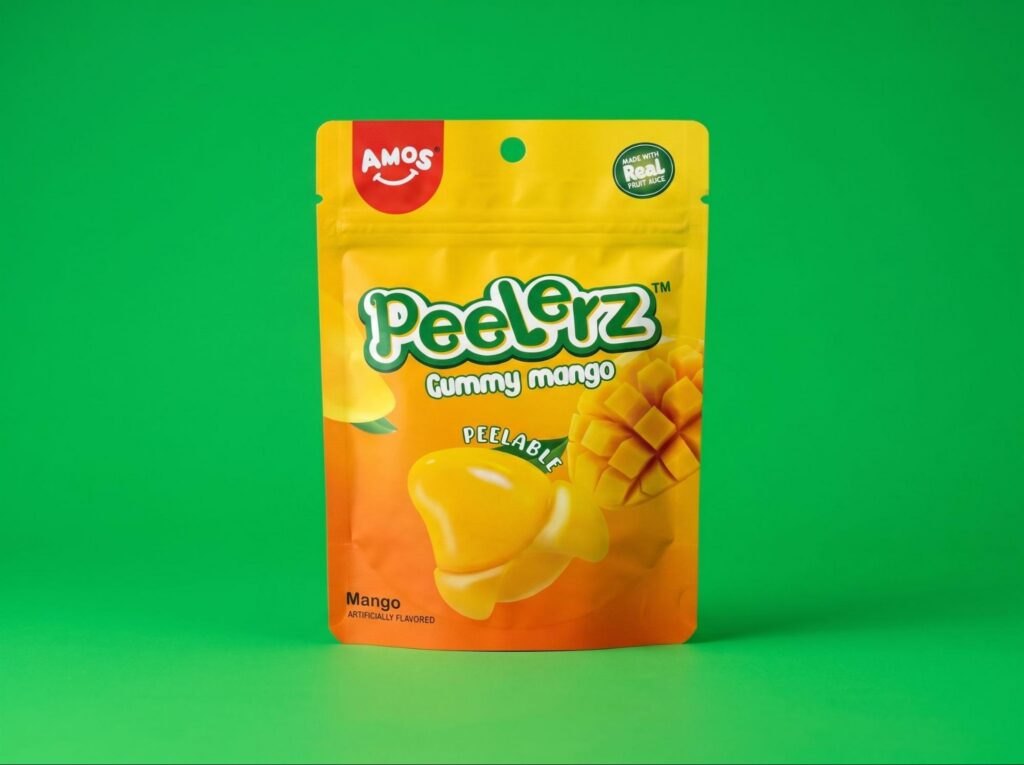
Peelerz, the peelable gummy line. The product mimics a real piece of fruit with a peelable outer skin that reveals a different-textured inner core when you pull it off.
At the 2024 Sweets & Snacks Expo, Peelerz took home two awards. Most Innovative New Product in Non-Chocolate Candy (Gummy Mango) and in Novelty/Licensed (Gummy Banana). They were the only brand to win two categories in the same year. Amos themselves claim: “Mango Peelerz are the most viral gummy on TikTok.” The 2025 International Taste Institute in Brussels followed with a Superior Taste Award. Validation that format and flavour can reinforce rather than trade off against each other.

Fruit Riot did something most snack brands would not consider – it put a snack in the freezer. The brand takes real, freshly frozen fruit and coats it in a tangy, sour candy shell. The result sits in the freezer aisle but competes with the candy shelf.
Founded in 2023, the brand commercialised a TikTok food hack that had been circulating since 2020; home cooks coating frozen grapes in citric acid and sugar. Fruit Riot turned a DIY viral trend into a retail product, and it spread the same way the hack did: through videos of people eating it for the first time and reacting to the combination of crunch, cold, and sour.
Store brands generated $271 billion in annual sales in the US in 2024, growing at nearly four times the rate of national brands. A 2024 NIQ report found that 70% of surveyed Gen Z & Millennials said that private labels are just as good as national brands and are even willing to pay more for them.
A brand competing only on flavor is now only a few months away from a store-brand version at half the price. A brand with a genuinely proprietary physical format is in a different position, as retailers cannot easily copy what they cannot manufacture.
One notable exception to this is a store-brand version of Peelerz under Walgreens’ Nice! label sold out across thousands of stores and hit a one-bag-per-customer online limit in early 2024, purely because people filmed themselves peeling it. Walgreens confirmed they paid no influencers. This goes to show that even private labels are catching up!
Social commerce has changed how snacks get discovered. First purchases increasingly happen because someone watched a video, not because they saw a shelf display. And here is the problem for flavour-first brands: you cannot taste a screen.
The hashtag #freezedriedcandy has 4.7 billion views on TikTok. A peelable mango gummy went viral purely because you could film yourself peeling it. Brands that build format-forward products are, in effect, building free media into the product itself.
Bakery & Snacks, citing Nestlé data, put it simply: “In 2026, texture is content.”
Bain’s 10th annual review tracking recent market shifts shows that a tiny cohort of 113 independent insurgent brands captured 36% of all US FMCG market growth, and specifically accounted for 25% of all growth in the food category. This growth wasn’t just driven by inflation or higher prices; it was powered by a massive 55% year-over-year volume expansion in a market where legacy volumes were largely flat. Consumers are actively moving their “share of wallet” away from legacy brands.
This increased competition is pushing brands to find new creative ways to differentiate themselves.
Social commerce has fundamentally changed the discovery funnel, first purchases increasingly happen because someone watched a video. The question to ask is not just “does this taste good?” but “is there a moment here worth filming?” If the act of eating your product contains no inherent visual or auditory drama, you are entirely dependent on paid media to communicate something that paid media cannot actually convey.
Looking to the future, the next frontier will be AI-driven discovery, and we have yet to see what the new differentiators will look like in a world where an algorithmic assistant, rather than a human eye, becomes the primary gatekeeper.
Private label has closed the flavour gap and it will eventually come for format too. The Walgreens Peelerz example is a warning to name brands, not just a proof point. Simple mechanics get copied. The brands with genuine long-term protection are those whose format depends on manufacturing processes that a generalist private-label operation cannot easily replicate.
Flavour got the snack industry to $31 billion. Format may be how the next generation of brands finds room to grow in a market where taste alone no longer moves the needle.
Flavour as mentioned at the top of this article, is arguably the most important element of any snack; however, in a hyper-competitive market where the baseline for taste is incredibly high, a great new flavour is table stakes. The fundamental challenge with a flavour-first strategy is that it requires physical trial for proof. In a digital-first world where discovery happens on a screen, that “trial barrier” makes it incredibly hard to win over new customers.
A product roadmap filled with new flavour SKUs is highly effective for customer retention and driving repeat purchases among people who already love your brand. It can sustain a business for a long time. However, flavour isn’t an engine for sustainable growth or long-term defensibility. Because any successful flavour can be replicated by a store brand within months, relying on flavour alone means you are constantly playing defence to protect your existing market share. Flavour keeps your current customers from getting bored, but format innovation can break through the noise to capture new ones. Why? Because it can create moments and content for social media and AI discovery that can create first time interest in your brand online in a way that flavour cannot.
Ultimately, you need both. The question every brand should be asking is not just “what’s our next flavour?” but also “what is our format strategy?”

135 W 41st St 5th Floor
New York NY 10036
+1 (212) 518-3444
Buspace
London
W10 5AP
