
AI hardware has had a bumpy start. The Humane Pin, for example, launched in April 2024 and was disconnected from its servers less than ten months later, having failed to offer enough utility to justify its price. Larger players have faced similar challenges: Meta’s glasses and new pendant have both attracted criticism for the perceived creepiness of their always-on design.
Ultimately, these products share the same fundamental flaw: the benefits of a dedicated AI device still cannot outweigh the convenience of an AI assistant on your smartphone, where it already has access to your messages, calendar and other essential information.
So the question becomes: what should AI hardware be? How do brands create something that motivates people to carry an additional device besides their phone? I believe the answer is in what I call Hollow Tech, or what techy people would call a DIY microcontroller.
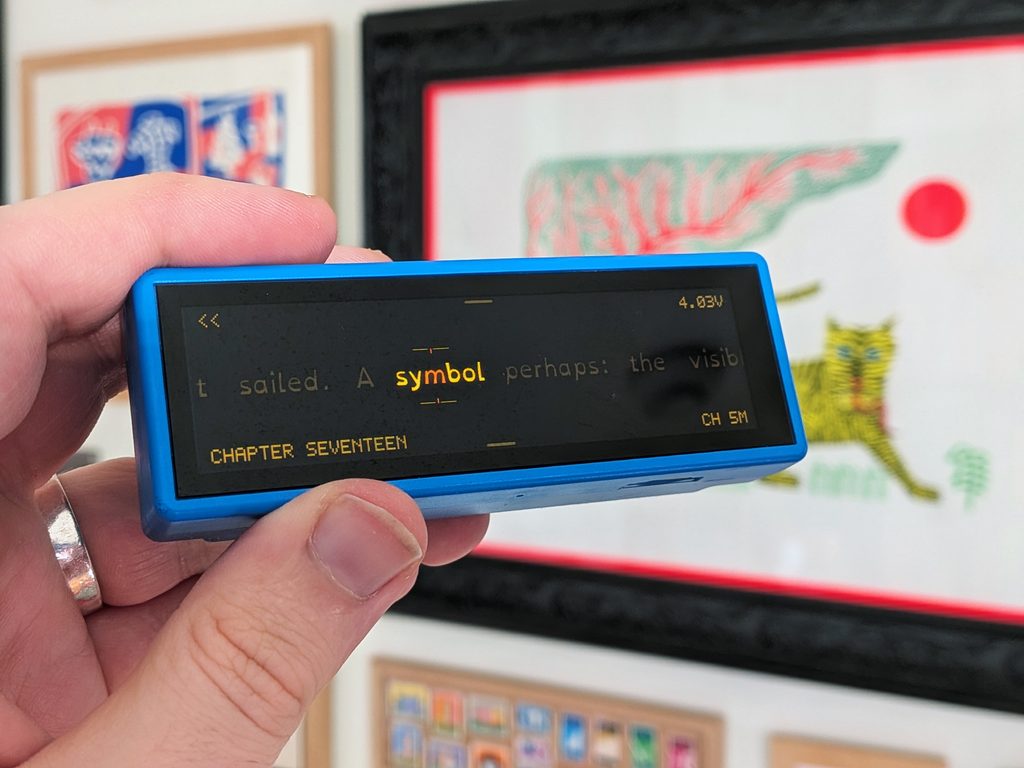
About 6 months ago, I came across a video by John Decebal showing off the RSVP Nano, a speed reader on a small touchscreen device. I immediately knew I wanted one. But, to my disappointment, I discovered it was actually a microcontroller kit that he had loaded his own software onto. I was invested, so I bought the pieces and loaded his open-source software. Notably, it took me months because this creation became so viral that the device was sold out everywhere. Since, it has become my go-to e-reader, all for less than $40.
Why am I telling you this story? Before AI, most people couldn’t create these devices themselves. They were reserved for people with technical skill. But now – thanks to the latest advances in AI coding – anyone can create an app and develop software. What people need is the device to load it onto. This is where I believe the future of AI hardware is: a device that hosts your AI creations, or what I call “Hollow Tech”.
You might be thinking, why not just build an app for your phone? After all, I made this argument for why AI hardware fails. Well, first of all, it’s not that easy to get an app onto your phone; for example, Apple is strict about what makes it onto their devices.
Then there’s focus. My RSVP reader does one thing, and that’s exactly why I use it. On my phone, reading is always one tap away from a notification or a scroll. Beyond this, there is something very human about the joy of owning a device that you know you played a role in creating. It’s yours in a way that nothing off the shelf can be.
This is a shift we’ve seen play out a few times: a skill becomes democratised, and new players swoop in to become the facilitator of this new hobby with the hardware or software to make it possible.
Take music creation. For years, it was limited to those who could play a musical instrument, or those with access to expensive recording studios. Then software like GarageBand and FL Studio became available, and some even bundled in with the laptop you bought; suddenly, anyone could produce a track. Hardware brands took note and developed tools. Novation, Akai and Arturia began selling compact MIDI keyboards and pad controllers, the little synth boards that now sit on every bedroom producer’s desk.
Or look at 3D printing: it existed for decades, but was expensive and limited to labs and factories. Then it became as affordable as a desktop printer, and anyone could print. Still, it was still limited to those with the skills to 3D model. Online marketplaces like Thingiverse, Printables and MakerWorld let people download thousands of designs other people had made, from a replacement dishwasher part or a phone stand to a custom board game insert, and print them at home. MakerWorld, the biggest of the three, boasts over 130,000 weekly users with an average of 6+ hours of engagement.
The thing that connects these examples is that in both situations the hardware was essentially hollow – an affordable solution to channel the user’s creativity. A MIDI controller makes no noise until it’s connected to the software, and a 3D printer cannot print without the file you’ve downloaded from MakerWorld. If I were Anthropic or OpenAI, I would not only be developing devices to host my AI; I would also consider hollow devices that people can host their creations on.
We’re already seeing companies create solutions to meet this growing demand. Espressif have created the ESP-Mosaico, a small modular device created specifically for AI coding, complete with the marketplace of other people’s creations.


So what could an AI company do differently from what is already being done? The answer comes in access, usability and polish.
Brands like Espressif still treat the AI space as one inhabited by coders, programmers and tinkerers. However, the truth is that an everyday person may now want to try their hand at this work. That means the experience of flashing software and using the device needs to be polished and the products need to be more consumer focused – considering form, not just function.
Here are some thought starters or provocations for the brands trying to develop the next must-have piece of AI hardware:
1. Stop trying to beat the smartphone
Every brand that has tried to replace the smartphone has failed. AI Hardware needs to provide alternative value, not compete on the same value points.
2. Also offer hollow tech
Akai didn’t write the songs, and Bambu Lab doesn’t design the models. They just made the tools. Brands should build a great home for people’s creations and let them fill it.
3. Give people somewhere to share
Not everyone will build. But everyone will browse; create a space to build community and share.
4. Use the makers who are already here
I only found my RSVP reader because John Decebal built it and shared it. People like him are already inventing new use cases and demonstrating the value of a device like this. Brands should be backing these creators and using them to show the art of the possible.
5. Make it consumer-focused
Tech companies are already building for this use case. But their focus is on those who are comfortable with hot-fixes, workarounds and hacking together open Arduino boards into devices that look like the prototypes they are. But your average Joe won’t want this experience. Make your products polished, clean and, importantly, user-friendly; think about the flashing process and how users will switch between apps on the device.
6. Make it affordable
There are two routes to affordability: either a single-use device that is relatively cheap, or a device that supports multiple pieces of software. Personally, I’d steer towards the former; it creates a higher sense of value to the artifact you’ve created, rather than just another phone with apps.
To see how this works in the wild, let’s look at a thought experiment: Pierre, our legally distinctive, french-named AI.
Pierre’s breakthrough is realizing that people don’t want another subscription-based pendant whispering in their ear. Pierre makes Boîte… Literally, a box.

Boîte is deliberately empty. It is premium, tactile, single-purpose hardware designed entirely to host whatever software you prompt into existence.
By taking care of the industrial design, supply chain and flashing interface, Pierre solved the ugly friction of bare circuit boards and soldering irons.
A Boîte is now the new homemade mixtape: an uncle making a toy for their nephew, a commuter making their own e-reader, a parent making their shopping trip a little easier, a busy exec making sure they are not disturbed in their client calls.


Beyond the hardware, Pierre has created the community surrounding Boîte, a community of everyone from curious hobbyists to die hard tinkerers, sharing their creations for others to use.

Want to explore what Hollow Tech would look like for your company?
Sense Worldwide partners with world-class and ambitious companies to create new categories, products and propositions. We help their brands thrive through cultural, brand and commercial strategies.
Get in touch to find out more.

135 W 41st St 5th Floor
New York NY 10036
+1 (212) 518-3444
Buspace
London
W10 5AP
