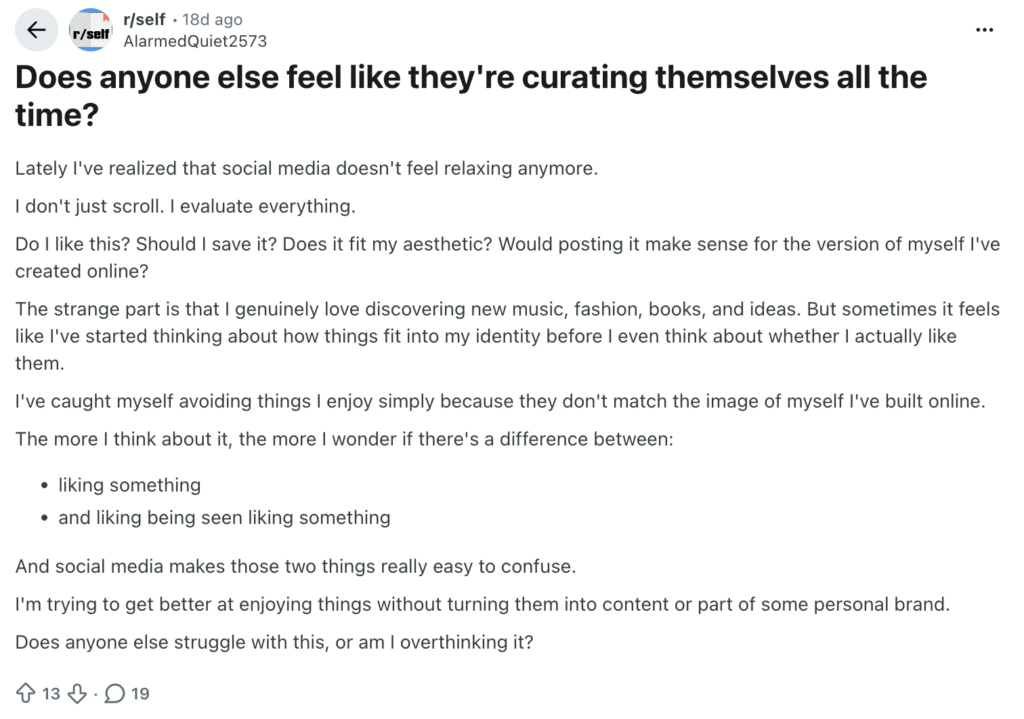
Before planning a weekend away, choosing a restaurant, or even deciding what to read next, people are discovering things through visual, curated platforms like Pinterest, Instagram, TikTok, and Google Lens. They screenshot, they save. Instead of typing keywords into a search bar, they build moodboards. For them, searching is less about the name of something and more about what it feels like.
That’s a shift that matters, because it changes the way taste works. People don’t always know how to articulate what they want in words, but they know it when they see it. In other words, aesthetics are becoming more important to discovery than semantics. And that doesn’t just mean a change in the interfaces we use – it signals a deeper cultural shift.
What’s emerging is a new logic of discovery: one organised less by clear categories than by vague aesthetics. Books are no longer “fiction”, “nonfiction”, “romance”, etc. On BookTok, they’re “books that feel like October” or “books that give Lana Del Rey energy.” Music is no longer chiefly sorted by genre; streaming platforms now sort it according to moods, moments, and atmospheres, into playlists of personalised recommendations with titles like “Daily Hype Mix” or “Hyped-up Summer Stroll”. Even a holiday, with a much higher price tag, isn’t chosen because of where or what the destination is but for how it’ll look and feel on a feed.
Categories used to be a way of making the world legible. They helped people decide what belonged where and how to find it. But our increasingly visual-first culture is making the resonance of a thing more important than its classification. The question is no longer “What is this?” but “Does this fit the mood I want?”
That represents a profound change in how people navigate culture. When the process of discovery becomes more visual, taste becomes more fluid, intuitive, and performative. A thing doesn’t need to be the best of its category; it just needs to be the right fit for a feeling.
The result is that aesthetic and sensory fluency becomes a form of cultural currency. If a restaurant, product, or brand looks and feels right, it’s more likely to be chosen, shared, and remembered. And if it doesn’t translate visually, it risks invisibility.
In this new paradigm, people are less loyal to one fixed tribe or category. Instead, they move between different aesthetics and vibes depending on mood, context, or season. They don’t belong to a single easily categorisable “type”; they’re a patchwork of selves.
We see this in the way people now speak of themselves in terms of “eras”: “I’m in my clean girl era,” “I’m in my indie sleaze era,” “I’m in my cosy autumn era.” Rather than identify with a stable identity, an individual adopts temporary masks, each signalling a new feeling for a specific moment.
This matters not least because it influences consumption. The things people buy are no longer just functional or symbolic in the old sense but are instead part of the ongoing editing process through which people shape how they appear to themselves and to others. A book, a coat, a playlist, a hotel, a coffee shop: all of these become props in the performance of a self that is always in motion.
The patchwork self is flexible, creative, and responsive, but it’s also more dependent on external cues. What used to be a relatively durable identity is now something that has to be continuously staged and restaged. If taste is now assembled through curation, then identity is too.
For brands, this poses a very different challenge. They’re no longer only competing within their own categories but on a broader aesthetic and sensory basis too. A café doesn’t just compete with other cafés; it competes with hotels, fashion brands, playlists, and homeware brands for the same vibe space.

Consequently, brand loyalty is becoming more and more situational. People don’t necessarily commit to brands anymore. They borrow them for a look, a mood, or a moment. A brand might be right for summer but wrong for winter: right for a night out and wrong for work, right for one self and irrelevant to another.
Before this shift, people used to return consistently to a brand they loved because it represented something stable about them. Now, loyalty rotates. Brands are selected according to the version of the self a person wants to inhabit in that moment.
That makes the old mode of brand building feel insufficient. Brands aren’t just being judged on recognition or trust. They’re being judged on whether they can participate in someone’s self-curation without feeling forced, generic, or out of place.
The age of curation isn’t just about better taste or prettier branding. It reveals a deeper shift in how people build identity: through selection, editing, and projection. That changes the job of a brand – it’s judged less on what it is and more on the room it gives customers to incorporate the brand into their story.
In a world where brands need to be visually recognisable to be chosen, shared, and remembered, there’s a temptation to become too complete: too polished, too readable, too obviously “on trend”. But total aesthetic clarity can be a trap. The more easily a brand is sorted, the more easily it can also be skipped the moment the vibe changes.
The brands that endure in this landscape are often not the most explicit. They’re the most suggestive. They hone a clear enough identity to be recognised but one with enough openness to be reinterpreted. That’s why brands like Muji, New Balance, and Carhartt keep being rediscovered by different subcultures: with a very distinct and clear brand DNA, they can credibly act like canvases, which encourage people to reinterpret and remix their items for new contexts.
Ultimately, there’s a difference between a brand that earns a place in someone’s self-curation and a brand that tries to buy one through trend-chasing or influencer placement. People can sense when a brand is “performing” a culture rather than genuinely participating in it. Forced participation breaks the fantasy that curation depends on: the feeling that people are authoring their own taste. They want to feel like they found something, not that it was handed to them.
This changes what brand loyalty means: it’s less about passive permanence and more about people actively returning to a brand over and over, on their journey of definition and redefinition. A strong brand won’t be the only thing in its customer’s home or wardrobe, but instead be the thing which one of that customer’s many selves regularly returns to. That forges a more fluid and, in many ways, more intimate relationship than traditional loyalty does – but it requires brands to let go of the idea that they can ever fully own the consumer.

135 W 41st St 5th Floor
New York NY 10036
+1 (212) 518-3444
Buspace
London
W10 5AP